



해당 글의 목차
What is the Roulette Fibonacci Strategy?
Roulette Fibonacci Strategy Concept
The Roulette Fibonacci strategy is a roulette betting strategy that uses the concept of the ‘Fibonacci sequence’ as the basis for setting betting amounts.
The Fibonacci sequence is a series where each number is the sum of the two preceding ones, like [1-1-2-3-5-8-13…]. It’s a concept found in various fields such as nature, finance, and art.
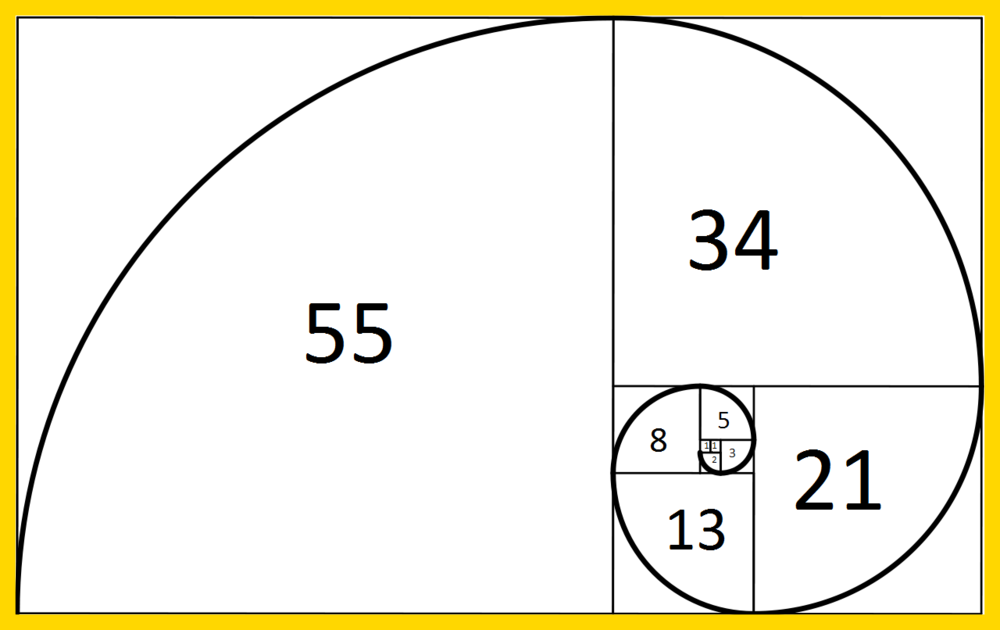
In this strategy, the Fibonacci sequence is not just a mathematical embellishment but serves as a reference table for progressively increasing betting amounts after a loss.
In other words, as a losing streak continues, the betting amount gradually moves to the next stage according to the Fibonacci sequence.
Negative Progression
The Roulette Fibonacci strategy is a betting strategy that falls under the ‘Negative Progression’ strategy.
A Negative Progression strategy is a high-risk method where you increase your betting amount after each loss, hoping to recover previous losses with a subsequent win.

- Upon losing: Increase betting amount
- Upon winning: Decrease or reset betting amount
Examples of Negative Progression strategies include the well-known ‘Martingale strategy’ and ‘D’Alembert strategy’.
However, the Roulette Fibonacci strategy differentiates itself from the others by using the concept of a ‘sequence’ rather than ‘multiples’ (Martingale) or ‘fixed unit increments’ (D’Alembert).
Why the Fibonacci Sequence?
The reason the Fibonacci sequence is used in roulette strategy is clear.
It mitigates the risk of a rapid increase in betting associated with Martingale, while offering a relatively faster potential for loss recovery compared to D’Alembert.
Viewing the three strategies from a sequence perspective reveals clear structural differences. Martingale can be seen as a geometric progression (1-2-4-8-16…), and D’Alembert as an arithmetic progression (1-2-3-4…).
| Category | Martingale | D’Alembert | Fibonacci |
| Betting Increase Method | Double (Geometric Progression) | +1 (Arithmetic) | Move to next sequence step |
| Speed of Increase During Losing Streak | Very Fast | Very Gradual | Gradual (Medium) |
| Loss Recovery Speed | Very Fast | Slow | Medium |
| Capital Required | Very Large | Relatively Small | Medium |
| Reaching Table Limit | Very Fast | Slow | Medium |
The Martingale strategy doubles the betting amount after each loss, which means there’s a high risk of hitting the capital limit or the table’s maximum betting amount after just a short losing streak.
On the other hand, the D’Alembert strategy only increases the bet by 1 unit after a loss, so the betting amount rises gradually. However, it takes a considerable amount of time to recover accumulated losses during a long losing streak.
The Fibonacci strategy can be seen as a middle ground between these two. The betting amount increases, but the rate of increase is slower than doubling and faster than a 1-unit increment.
Due to these characteristics, the Roulette Fibonacci strategy is known among roulette players as a “strategy that somewhat suppresses risk while also being advantageous for recovering losses.”
Roulette Fibonacci Strategy Rules
Applicable Bets
The Roulette Fibonacci strategy cannot be applied to all roulette bets.
Structurally, it should only be used for bets with 1:1 odds.
The Fibonacci strategy applies to the following:

- Red/Black
- Odd/Even
- High (19-36)/Low (1-18)
Unlike inside bets, dozens, or column bets, these bets have a relatively high probability of winning, close to 50% (48.65% for European Roulette), and align best with the underlying structure of negative progression strategies.
Basic Rules
The rules of the Fibonacci strategy are very simple if you understand the concept of the sequence.
① Start
Set your betting unit based on the Fibonacci sequence.
- Start with the first value of the sequence, 1 → Bet 1 chip
② On Loss
If you lose, move to the next Fibonacci step and increase your betting amount.
- 1st loss → 1 chip
- 2nd loss → 1 chip
- 3rd loss → 2 chips
- 4th loss → 3 chips (sequence 1-1-2-3…)
③ On Win
If you win, move back two steps from your current position.
If there is no value two steps back, reset your betting amount to 1 chip.
- After 3 losses, if you win → Bet 1 chip
Betting Changes on Loss/Win
The core rule of the Fibonacci strategy is moving steps based on wins and losses.
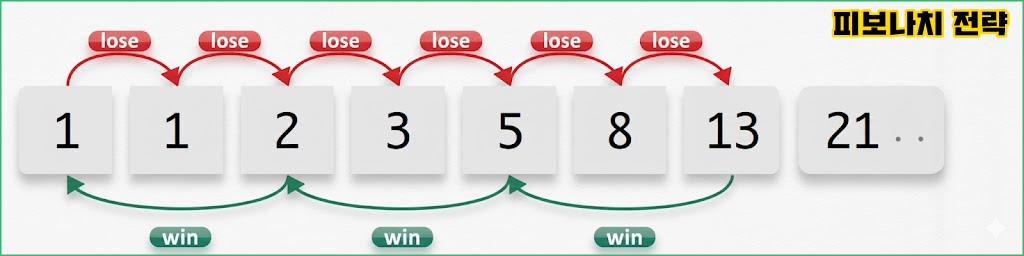
- On Loss
→ Move to the next step in the Fibonacci sequence (e.g., 2→3, 3→5)
- On Win
→ Move two steps back in the Fibonacci sequence (e.g., 5→2, 8→3)
This rule is designed not just to reduce or increase the betting amount, but to clear the losses of the previous two steps at once.
This is precisely why the Roulette Fibonacci strategy gives the impression of faster loss recovery than D’Alembert.
Real-world betting examples
- Betting Unit: 10,000 KRW
- Using Fibonacci strategy (Progression: 1→1→2→3→5→8→13…)
- Betting Target: 1:1 odds (Red, Black, Odd, Even, Low, High)
| Round | Sequence Step | Bet Amount (KRW) | Result | Cumulative P/L (KRW) |
| 1 | 1 | 10,000 | Loss | -10,000 |
| 2 | 1 | 10,000 | Loss | -20,000 |
| 3 | 2 | 20,000 | Loss | -40,000 |
| 4 | 3 | 30,000 | Loss | -70,000 |
| 5 | 5 | 50,000 | Win | -20,000 |
| 6 | 2 | 20,000 | Win | 0 |
| 7 | 1 | 10,000 | Win | +10,000 |
Commentary
- 4 consecutive losses, betting amount increased to 50,000 KRW, which is the 5th step of the Fibonacci sequence.
- After winning in the 5th round, move back 2 steps in the sequence; the betting amount is 20,000 KRW, which is the 3rd step.
- After winning in the 6th round, move back 2 steps in the sequence; the betting amount is 10,000 KRW, which is the 1st step → Cycle ends.
- Win in the 7th round, final profit of +10,000 KRW with 3 wins and 4 losses in 7 games.
Roulette Fibonacci Strategy Risks
As seen in the previous example, the Fibonacci strategy allows a cycle to conclude successfully even with a low win rate, provided a winning streak occurs at some point after an initial losing streak.
In this process, it’s possible to recover losses close to the break-even point, or even achieve a small profit in some cases.
However, on the flip side of these advantages, the Fibonacci strategy also carries a structural risk: if a losing streak extends beyond a certain point, it becomes difficult to recover losses.
Now, let’s examine a scenario where a losing streak continues under the same conditions.
Example of Betting Progression During Consecutive Losses
- Betting Unit: 10,000 KRW
- Using Fibonacci strategy (Progression: 1→1→2→3→5→8→13→21…)
- Betting Target: 1:1 odds (Red, Black, Odd, Even, Low, High)
| Round | Sequence Step | Bet Amount (KRW) | Result | Cumulative P/L (KRW) |
| 1 | 1 | 10,000 | Loss | -10,000 |
| 2 | 1 | 10,000 | Loss | -20,000 |
| 3 | 2 | 20,000 | Loss | -40,000 |
| 4 | 3 | 30,000 | Loss | -70,000 |
| 5 | 5 | 50,000 | Loss | -120,000 |
| 6 | 8 | 80,000 | Loss | -200,000 |
| 7 | 13 | 130,000 | Loss | -330,000 |
| 8 | 21 | 210,000 | Win | -120,000 |
Commentary
First, after 7 consecutive losses from the 1st round, the betting amount increased to 210,000 KRW (21st step of the Fibonacci sequence).
Even after winning in the 8th round, the cumulative loss still stands at -120,000 KRW. Considering the betting unit and the corresponding capital size, it’s clear that a significant loss is still present.
This example highlights the most crucial characteristic of the Fibonacci strategy.
‘The longer the losing streak, the harder it is to recover losses with just one win.’
Even if you move back two steps in the sequence after a win, according to the rules, the accumulated losses are already substantial. Therefore, additional consecutive wins are needed to successfully complete the cycle.
However, the problem is that expecting such a streak is just as unlikely, probabilistically, as the devastating losing streak that preceded it.
Risk Explanation
- As losing streaks deepen, the required capital increases exponentially beyond a certain point (…5→8→13→21→34→54…)
- As betting amounts grow, psychological pressure intensifies, making it difficult to decide to cut losses.
- A single win only temporarily delays losses rather than recovering them.
- Consequently, you quickly reach your capital limit or the table’s maximum betting amount.
Thus, while the Fibonacci strategy may appear to have recovery power during short losing streaks, it can become even more disadvantageous than the D’Alembert strategy once a losing streak exceeds a certain level.
Advantages and Disadvantages of the Roulette Fibonacci Strategy
The Roulette Fibonacci strategy is considered a relatively balanced approach among negative progression strategies.
However, its advantages and disadvantages are clearly intertwined, and approaching it from only one perspective can easily lead to a misunderstanding of the strategy’s essence.
✅ Advantages
1. Lower Risk than Martingale: Unlike Martingale, where betting amounts double after a loss, the Fibonacci strategy increases bets incrementally according to the sequence, meaning capital is depleted relatively slower.
2. Faster Loss Recovery Structure than D’Alembert: Thanks to the rule of moving back two steps after a win, it appears to recover losses faster than D’Alembert under the same conditions.
3. Intuitive Betting Flow: Because betting progresses according to a sequence, it’s easy to grasp your current position and risk level at a glance.
❌ Disadvantages
1. Highly Vulnerable to Losing Streaks: The Fibonacci strategy, like other negative progression systems, involves progressively larger bets during losing streaks.
Beyond a certain point, it becomes virtually impossible to recover accumulated losses with just one win.
2. Unchanging Expected Value: The Fibonacci strategy also cannot overcome the house edge of roulette (2.7% for European, 5.26% for American), and in the long run, it cannot escape a negative expected value structure.
3. Higher Capital Requirements Than Expected: As the Fibonacci sequence progresses, the required betting amounts increase surprisingly quickly.
Without sufficient bankroll, even a few consecutive losses can make it difficult to maintain the strategy.
4. Unsuitable for Long-Term Play: Considering the risk of losing streaks and the house edge, the Roulette Fibonacci strategy is not suitable for extended play.
If it’s not based on short sessions, risks accumulate quickly.
Who is the Roulette Fibonacci Strategy Suitable For?
As seen in the advantages and disadvantages section, the Fibonacci strategy is not universally suitable for all roulette players.
This strategy is only meaningful when the purpose of use and playing style are clear; otherwise, its drawbacks may become more prominent.
Below, we will distinguish between cases where the Fibonacci strategy is suitable and where it is not.
✅ When the Strategy is Suitable
1. Short Session Players: If you set clear termination criteria and play for short periods, you can manage the flow without drastic betting increases.
2. Those who want to practice betting flow and money management concepts: Thanks to its sequence-based structure, it’s easy to understand your current stage and risk level, making it valuable as a tool for practicing money management strategies.
3. Those who prefer emotion-free, rule-based play: The existence of clear rules helps to curb impulsive betting.
❌ When the Strategy is Not Suitable
1. Long-term profit-seeking players: If a losing streak occurs, there’s a high probability of losing all small accumulated profits in a short period.
2. Players who struggle with cutting losses: The Fibonacci strategy has a structure where it’s difficult to recover losses immediately with a single win, so expecting a quick recovery can cloud judgment.
Premises and Limitations of the Roulette Fibonacci Strategy
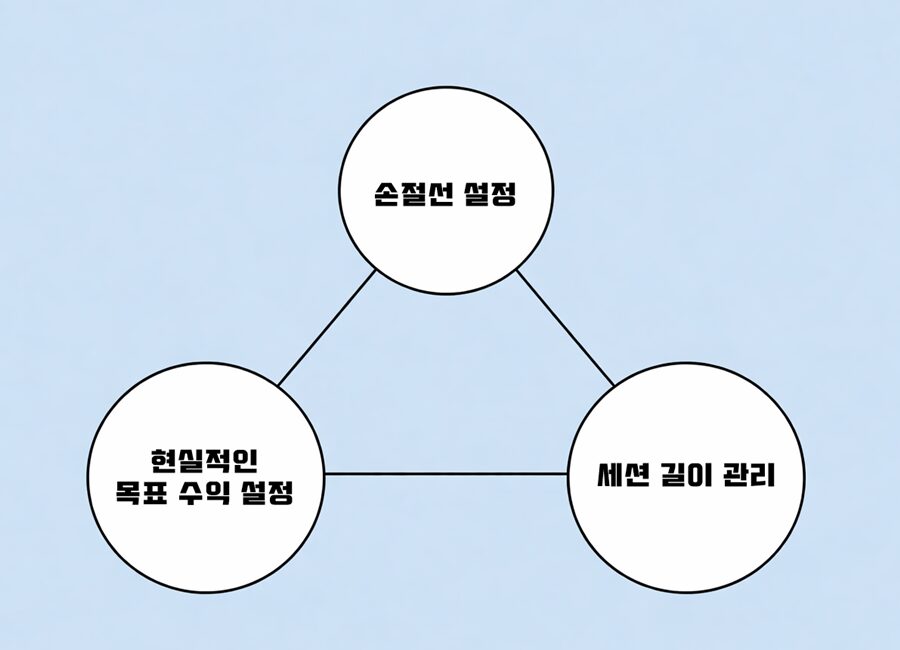
Criteria you must set when using strategies
The Fibonacci strategy is one where the outcome largely depends on how it’s used, rather than just the rules themselves.
Therefore, before applying the strategy, you must set a few criteria.
-
Setting a Stop-Loss Limit
The Roulette Fibonacci strategy has a structure where it’s difficult to recover accumulated losses quickly during a losing streak. Therefore, if you don’t have a criterion to immediately end the session when losses exceed a certain level, losses can snowball.
Playing without a stop-loss is not a problem with the strategy itself, but rather a failure in its implementation.
-
Setting Realistic Profit Targets
The Roulette Fibonacci strategy is not a high-risk strategy aimed at high profits; it’s a strategy focused on managing the flow over short periods.
The more you extend your sessions hoping for big profits, the higher the probability of encountering losing streaks.
It is crucial to have the discipline to quit without hesitation once your profit target is reached.
-
Managing Session Length
Regardless of the strategy, the longer you play, the higher the chance of encountering unfavorable periods.
Especially with the Roulette Fibonacci strategy, there’s a risk of the sequence deepening over time, so setting a session end point in advance is key to money management.
Most Common Mistakes in the Fibonacci Strategy
When using the Fibonacci strategy without clear criteria, several mistakes can occur.
Typical examples include arbitrarily changing rules after a losing streak, skipping steps, or extending sessions under the misconception that “it’s due to hit this time” (gambler’s fallacy).
Additionally, excessively increasing betting amounts in a rush to recover losses is a major reason for the strategy’s failure.
Conclusion
Even the Roulette Fibonacci strategy, considered more balanced than Martingale or D’Alembert, is not a magic bullet for beating the casino.
The essence of this strategy is not to change probabilities, but to manage the flow of betting amounts and playing time.
While risky if used without clear criteria, it can be a tool to facilitate relatively stable play in short sessions if stop-loss limits, profit targets, and session lengths are strictly adhered to.
It’s important to recognize that the Fibonacci strategy is more of an ‘operational strategy’ than a ‘profit strategy.’
Roulette Fibonacci Strategy FAQ
Q1. How many consecutive losses can it withstand?
A. There’s no fixed answer. It depends on your basic betting unit, bankroll size, and the table’s maximum betting limit. However, the required capital increases rapidly as losing streaks lengthen.
Q2. Can it be applied to online roulette as well?
A. The rules themselves are the same, but online roulette progresses faster, which can expose you to losing streaks more quickly. Beginners may find it difficult to make betting decisions.
“This post is for informational purposes to help you understand the game in countries and regions where it is legal.”